

Search is no longer just about Google rankings.
Today, people are asking questions directly to tools like ChatGPT, Google AI, Alexa, and Siri — and they get instant answers without even visiting a website.
This shift has created something new called Answer Engine Optimization (AEO).
In this guide, you’ll understand AEO in simple language, along with practical strategies you can actually use.
What is AEO?
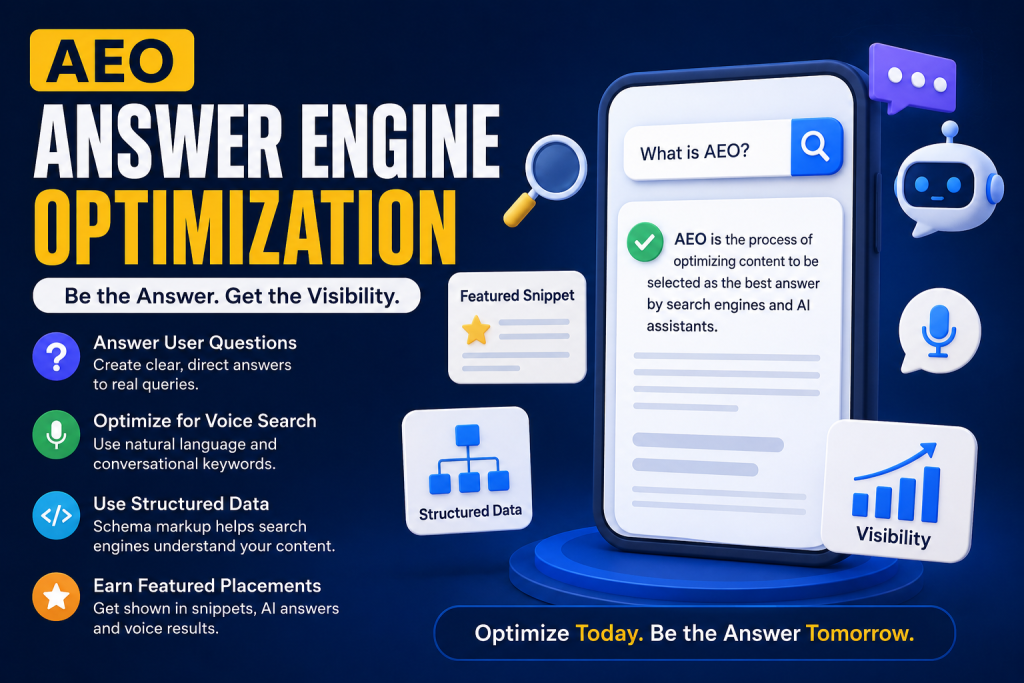
Answer Engine Optimization (AEO) is the process of optimizing your content so that it becomes the direct answer shown by AI tools and search engines.
Earlier:
- Users searched → saw links → clicked websites
Now:
- Users ask → get direct answers instantly
👉 AEO helps your content become that answer.
Simple Definition:
AEO = Optimizing content to be selected and shown as the final answer by AI tools.
Why AEO is Important in 2026
User behavior has completely changed.
People today:
- Ask full questions instead of typing keywords
- Use voice assistants more
- Expect instant, clear answers
Example:
- Old search: “best SEO tools”
- New search: “Which are the best SEO tools for beginners and why?”
👉 AI tools prefer content that:
- Clearly answers questions
- Is easy to understand
- Is structured properly
If your content is not optimized for this, you’re missing a big opportunity.
AEO vs Traditional SEO (Detailed Understanding)
| Factor | Traditional SEO | AEO |
|---|---|---|
| Goal | Rank on Google | Become the answer |
| Focus | Keywords | Questions & intent |
| Traffic | Website clicks | Visibility & mentions |
| Format | Long content | Clear, structured answers |
| User journey | Click → Read | Instant answer |
👉 Important:
AEO does NOT replace SEO — it works alongside it.
How AEO Actually Works
Answer engines (like Google AI or ChatGPT) scan content and select answers based on:
1. Clarity
Content should be easy to understand without confusion.
2. Structure
Well-organized content (headings, bullet points, sections).
3. Direct Answers
The answer should be clearly written — not hidden.
4. Trust Signals (E-E-A-T)
- Experience
- Expertise
- Authority
- Trust
5. Context & Relevance
Content should match exactly what the user is asking.
👉 If your content ticks all these boxes, it has a high chance of being picked.
Best AEO Strategies (Detailed + Actionable)
1. Use Question–Answer Format
Instead of writing random paragraphs, structure your content like this:
Example:
👉 What is AEO?
👉 How does AEO work?
Then answer immediately below.
Why this works:
- Matches how users search
- Easy for AI to extract
- Improves featured snippet chances
2. Give Direct Answers First
Always answer the question in the first 2–3 lines.
Then explain in detail below.
👉 This increases your chances of:
- Featured snippets
- Voice search results
- AI citations
3. Keep Answers Short but Clear
Ideal length:
- 40–60 words → Google snippets
- 20–30 words → Voice search
👉 Avoid:
- Long explanations before answering
- Complex sentences
4. Write in Simple, Conversational Language
Avoid technical or robotic writing.
Instead:
- Write like you’re talking to a beginner
- Use simple words
- Keep sentences short
👉 AI tools prefer natural language because that’s how users speak.
5. Use Schema Markup (Very Important)
Schema helps search engines understand your content better.
Top types:
- FAQ Schema
- How-To Schema
- Article Schema
Benefits:
- Better visibility
- Higher chance of rich results
- Easier content understanding for AI
6. Target Long-Tail & Question Keywords
Focus on real questions like:
- “What is AEO in SEO?”
- “How to optimize content for AI search?”
👉 These keywords:
- Have less competition
- Are highly targeted
- Work best for AEO
7. Build Topical Authority
Don’t just write one blog.
Create multiple blogs around one topic.
Example:
- What is AEO
- AEO vs SEO
- AEO tools
- AEO strategy
👉 This builds trust and authority in the eyes of AI.
8. Use Proper Content Structure
Structure your blog like this:
- Clear headings (H1, H2, H3)
- Bullet points
- Short paragraphs
- Lists & steps
👉 This improves readability for both users and AI.
Optimizing for Voice Search (Detailed)
Voice search is growing rapidly.
People speak differently than they type.
Example:
Typed: “SEO tips”
Spoken: “What are the best SEO tips for beginners?”
How to optimize:
- Use natural language
- Answer question-based queries
- Keep answers short and direct
- Focus on “who, what, why, how”
👉 Voice assistants usually pick one best answer — aim to be that.
Featured Snippets (Your Biggest Opportunity)
Featured snippets appear at the top of Google results.
To rank there:
- Answer questions clearly
- Use bullet points or steps
- Keep answers concise
- Use question-based headings
👉 This is the fastest way to gain visibility without ranking #1.
Common AEO Mistakes (Avoid These)
❌ Writing long, confusing paragraphs
❌ Not answering questions directly
❌ Ignoring voice search queries
❌ No schema markup
❌ Using complex language
❌ Weak content structure
👉 Fixing these alone can improve your results significantly.
Real Benefits of AEO
When you implement AEO correctly:
✔ Your content appears in AI answers
✔ You get featured in snippets
✔ Your brand visibility increases
✔ You build authority in your niche
👉 Even without clicks, users start trusting your brand.
Step-by-Step: How to Start AEO
- Find questions your audience asks
- Rewrite content in Q&A format
- Add direct answers at the top
- Use schema markup
- Improve structure and readability
- Track performance
Future of AEO
Search is moving towards:
- AI-generated answers
- Voice-first interactions
- Zero-click searches
👉 In future:
- Ranking alone won’t be enough
- Being the answer will matter most
What This Means for Your Business
Search is no longer just about rankings — it’s about visibility in answers.
If your content is not structured to directly answer user questions, you’re already falling behind in the AI-driven search landscape.
AEO is your opportunity to:
- Get featured without relying only on rankings
- Build authority in your niche
- Stay visible even in zero-click searches
👉 The shift is simple but powerful:
Don’t just create content to rank — create content that answers better than anyone else.