


“If it’s not on the first page of Google, it doesn’t exist.”
That line may sound extreme, but it reflects how people actually search today. Most users never go beyond the first page. If your website is not there, you are missing out on traffic, leads, and sales.
But here’s the good news — ranking #1 on Google is possible if you follow the right strategy. You don’t need tricks or shortcuts. You need a clear plan, consistency, and patience.
In this guide, you’ll learn a simple, step-by-step method to help your website move up in Google rankings.
Step 1: Start With Smart Keyword Research
Before creating content, you need to know what people are searching for.
This is called keyword research.
Many beginners make the mistake of guessing keywords. But guessing does not work. You need real data.
What to Look For:
- Keywords with good search volume
- Low to medium competition
- Clear user intent (what the user actually wants)
Types of Keywords:
- Short keywords: Example – “SEO”
- Long-tail keywords: Example – “how to rank website on Google step by step”
Long-tail keywords are easier to rank and often bring better results because they target specific users.
Simple Tip:
Instead of using a broad keyword like “digital marketing,” try something more specific like “best digital marketing services for small business.”
This helps you reach the right audience.
Step 2: Understand Search Intent
Search intent means why someone is searching.
Google always tries to show results that match the user’s intent.
Types of Search Intent:
- Informational: “How to do SEO”
- Navigational: “Facebook login”
- Transactional: “Buy SEO tools”
If your content does not match the intent, it will not rank.
Example:
If someone searches “how to rank #1 on Google,” they want a guide, not a sales page.
So always ask:
What is the user expecting from this search?
Then create content based on that.
Step 3: Fix Your Technical SEO
Technical SEO is the foundation of your website.
If your site has technical problems, it will struggle to rank no matter how good your content is.
Important Technical SEO Factors:
- Mobile-friendly design
Most users browse on mobile. Your site must look good and work well on phones. - Fast loading speed
Slow websites lose visitors. Aim for a fast loading time. - Secure website (HTTPS)
Security is a ranking factor. - Clean URL structure
Keep URLs simple and readable. - Fix broken links
Broken links harm user experience. - XML sitemap
Helps search engines understand your site structure.
Simple Tip:
Think of technical SEO like building a house. If the base is weak, everything else will fall.
Step 4: Create High-Quality Content
Content is the most important part of SEO.
Google wants to show the best and most helpful content to users.
So your goal is to create content that is better than what already exists.
How to Create Great Content:
- Write detailed and useful articles
- Answer common questions clearly
- Use simple and easy language
- Add examples and real value
- Keep your content well-structured
Content Length:
Longer content often performs better, but only if it is useful. Do not add unnecessary words.
Simple Tip:
Ask yourself:
“If I were the reader, would this content fully solve my problem?”
If the answer is yes, you are on the right track.
Step 5: Optimize On-Page SEO
On-page SEO helps Google understand your content.
It also improves user experience.
Key On-Page SEO Elements:
- Title Tag
Include your main keyword. - Headings (H1, H2, H3)
Use clear headings to organize content. - First 100 words
Add your keyword early in the content. - URL
Keep it short and keyword-rich. - Meta Description
Write a clear and attractive summary. - Internal Linking
Link to other pages on your site. - Image Optimization
Use alt text for images.
Simple Tip:
Do not overuse keywords. Keep it natural.
Step 6: Build High-Quality Backlinks
Backlinks are links from other websites to your site.
They act like votes of trust.
The more high-quality backlinks you have, the more Google trusts your site.
Ways to Get Backlinks:
- Write guest posts on other blogs
- Create valuable content people want to share
- Reach out to websites in your niche
- List your business in directories
Important:
Quality matters more than quantity.
One strong backlink is better than many weak ones.
Step 7: Focus on User Experience
Google cares about how users interact with your site.
If users leave quickly, your rankings can drop.
Improve User Experience By:
- Using simple design
- Writing short paragraphs
- Adding bullet points
- Making content easy to read
- Avoiding too many ads
Key Metrics:
- Bounce Rate – Do users leave quickly?
- Time on Page – Do users stay and read?
- Click-Through Rate (CTR) – Do users click your link?
Simple Tip:
Make your content easy to scan and read.
Step 8: Optimize for Local SEO (If Needed)
If you run a local business, local SEO is very important.
It helps you appear in searches like:
“SEO agency near me”
Local SEO Tips:
- Create a business profile on Google
- Add your address and contact details
- Get customer reviews
- Use location-based keywords
Example:
Instead of “SEO services,” use “SEO services in Delhi”
This helps you rank locally.
Step 9: Keep Updating Your Content
SEO is not a one-time task.
You need to keep improving your content.
What to Update:
- Add new information
- Fix outdated data
- Improve readability
- Add new keywords
Google prefers fresh and updated content.
Step 10: Track and Improve Performance
You cannot improve what you don’t measure.
So always track your results.
What to Track:
- Keyword rankings
- Website traffic
- Click-through rate
- Conversions
Simple Tip:
If something is not working, change your strategy.
SEO is about testing and improving.
Final Thoughts: Ranking #1 Takes Time — But It Works
There is no magic trick to rank #1 on Google.
It takes time, effort, and consistency.
But if you follow the steps in this guide:
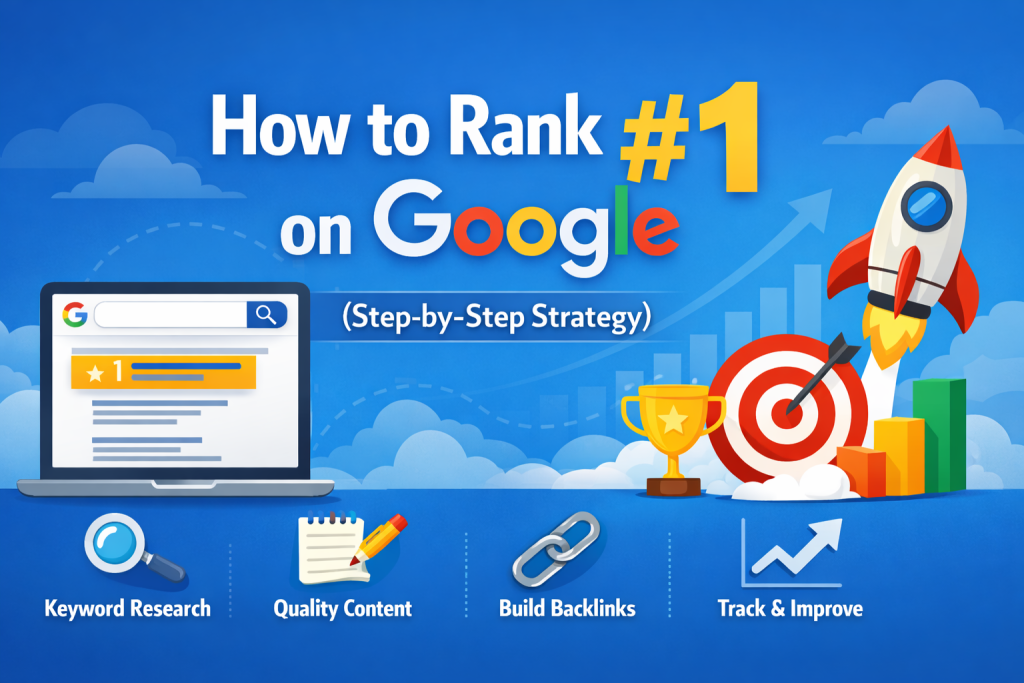
- Choose the right keywords
- Create helpful content
- Optimize your website
- Build quality backlinks
You will start seeing results.
Even small websites can compete with big ones if they focus on quality and user value.
Stay consistent, keep learning, and keep improving.
That’s the real secret to ranking #1 on Google.