

For B2B founders and marketing executives, the cost of customer acquisition (CAC) has turned into an ongoing battle. Acquiring customers through paid channels has steadily grown more expensive as ad networks face increased saturation, rising bid prices, and stiffer competition. Across enterprise software, professional services, and tech, standard pay-per-click (PPC) bids frequently run anywhere from $10 to well over $100 for a single click.
The primary structural problem with relying exclusively on paid channels is simple: the moment you reduce your ad spend, your lead pipeline stops entirely.
To build a scalable marketing engine, B2B companies eventually face a foundational strategic choice: Should you continue pouring capital into Pay-Per-Click (PPC) advertising for immediate visibility, or build a lasting acquisition channel through Search Engine Optimization (SEO)?
When evaluating these channels strictly on their ability to drive down customer acquisition costs while scaling lead volume over time, the long-term mechanics favor a clear winner.
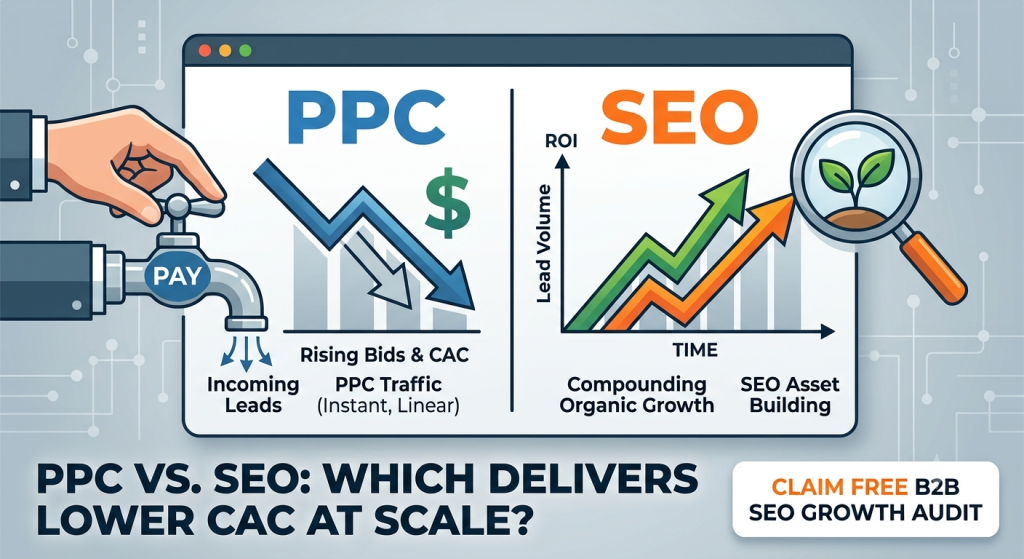
The Core Math of B2B Customer Acquisition Cost (CAC)
To accurately evaluate PPC against SEO, CAC must be viewed through a comprehensive formula rather than just ad network line items. Fully loaded Customer Acquisition Cost includes every dollar invested in bringing in a closed deal:
  Traditional Paid Model (Linear Cost Curve)
  [ Spend $25,000 ]  -->  [ 250 Leads ]  -->  CAC = $100 per lead
  [ Spend $50,000 ]  -->  [ 500 Leads ]  -->  CAC = $100 per lead (Zero compounding advantage)

  SEO Engine Model (Compounding Asset Curve)
  [ Year 1: $60,000 Spend ]  -->  [ 300 Leads ]   -->  CAC = $200 per lead
  [ Year 2: $60,000 Spend ]  -->  [ 1,200 Leads ] -->  CAC = $50 per lead
  [ Year 3: $60,000 Spend ]  -->  [ 3,000 Leads ] -->  CAC = $20 per lead
The difference in performance between PPC and SEO boils down to capital efficiency as volume increases.
Analyzing PPC: Rapid Speed with Fixed, Linear Costs
PPC channels—such as Google Search Ads, LinkedIn Sponsored Content, and targeted display networks—function like a tap. Opening the tap generates instant, qualified traffic directly to your conversion pages.
Key Strengths of PPC
-
Immediate Feedback and Lead Velocity: Ads go live in hours, providing instant visibility, real-time feedback on user behavior, and immediate sales opportunities.
-
Granular Audience Targeting: Paid platforms allow precise targeting based on job titles, company size, specific industries, or active intent keywords.
-
Predictable Pipeline Forecasting: Known click-through rates, conversion rates, and cost-per-lead (CPL) metrics make short-term pipeline modeling straightforward and reliable.
The Trade-off: The Linear Spend Trap
The central weakness of PPC is its linear unit economics. Generating twice as many leads generally requires spending twice as much money.
Furthermore, as you attempt to scale spend to capture more market share, you are forced to bid on broader, less targeted keywords or expand into less receptive demographics. As a result, marginal CAC often increases as budget expands.
       PPC Cost Trajectory                SEO Cost Trajectory
  CAC                                 CAC
   ^     / Increased Bidding           ^ \
   |    /  & Market Saturation         |  \ High Upfront Asset Creation
   |   /                               |   \
   |  /-- Constant Baseline Spend      |    \____ Long-Term Efficiency Gains
   +----------------------->           +--------------------------->
            Ad Spend                                 Ad Spend
Analyzing SEO: High Initial Effort with Compounding Paybacks
SEO operates as an asset-building strategy. Instead of renting placement on a search result page on a per-click basis, you invest in content, site architecture, and digital authority. Once established, these assets generate ongoing organic traffic without incurring a direct cost for every additional visitor.
Key Strengths of SEO
-
Compounding Returns & Shrinking CAC: High-ranking editorial guides, landing pages, and product pages continue to draw searchers for years. The initial cost of creating the page gets distributed across an ever-growing pool of acquired leads, driving unit CAC downward over time.
-
Stronger Buyer Trust: Many B2B buyers intentionally bypass sponsored links. Appearing naturally at the top of organic search results positions your company as a primary authority in the space rather than just an advertiser.
-
Complete Funnel Coverage: SEO enables you to connect with prospects throughout their entire decision-making journey—capturing educational searches at the top of the funnel, product comparisons in the middle, and high-intent software searches at the bottom.
The Trade-off: Upfront Delay
Building search authority requires steady investment before organic traffic ramps up. During the initial months of technical setup, research, and content creation, your CAC will appear high because spend precedes results.
Direct Comparison: PPC vs. SEO
| Key Dimension | Pay-Per-Click (PPC) | Search Engine Optimization (SEO) |
| Speed to Results | Immediate (24 to 48 hours) | Gradual (3 to 6 months to build momentum) |
| Cost Curve at Scale | Linear to Inflationary | Compounding (Marginal cost per lead trends lower) |
| Long-Term Asset Value | Zero (Traffic ends when budget stops) | High (Content and domain authority remain active) |
| Targeting Precision | High (Direct control over demographics and keywords) | High (Captures specific active search intent) |
| Conversion Efficiency | Strong on direct conversion pages | Strong across the entire research and buying journey |
Which Model Delivers Lower CAC at Scale?
When evaluated over time and at scale, SEO consistently achieves a significantly lower CAC than PPC for B2B lead generation.
PPC remains essential for rapid testing, immediate pipeline injection, and targeting specific accounts. However, relying on it as your sole engine creates a pay-to-play framework that becomes cost-prohibitive as keyword auction costs rise.
SEO transforms marketing spend from a continuous operational expense into a permanent business asset. Once your platform earns top rankings for high-intent search phrases—such as “best enterprise [category] platform” or “how to solve [industry challenge]”—the marginal cost of capturing every subsequent lead approaches zero.
Strategic Implementation: The Hybrid CAC Engine
The most efficient B2B growth programs do not treat this choice as an either-or scenario. Instead, they run a coordinated strategy where PPC funds short-term opportunities while SEO builds long-term cost efficiency:
  Phase 1: Initial Growth Engine (Months 1–3)
  [ PPC: 80% Allocation ]  --> Capture high-intent searches immediately
  [ SEO: 20% Allocation ]  --> Audit technical architecture & publish core pillars

  Phase 2: Transition Stage (Months 4–9)
  [ PPC: 50% Allocation ]  --> Trim low-converting, high-cost ad keywords
  [ SEO: 50% Allocation ]  --> Organic rankings begin generating steady lead volume

  Phase 3: Scaled Dominance (Months 10+)
  [ PPC: 20% Allocation ]  --> Focused retargeting & protecting brand keywords
  [ SEO: 80% Allocation ]  --> Primary acquisition engine driving lowest overall CAC
-
Test Messaging via PPC: Use small paid campaigns to validate keywords, ad copy, and landing page conversions before creating comprehensive organic content assets.
-
Convert Winning Paid Keywords into Organic Assets: Identify top-performing paid search queries and build dedicated, authoritative organic content around them to capture that market share long-term without ongoing click costs.
-
Retarget Organic Traffic: Use low-cost top-of-funnel SEO content to attract relevant decision-makers, then run targeted paid retargeting ads to guide them toward demo requests or sales calls. This approach combines the broad reach of organic search with the precision of paid ads at a fraction of standard PPC acquisition costs.
Take the Next Step Toward Scalable Growth
Continuing to rely entirely on rising ad spend puts pressure on margins and limits sustainable growth. To build a predictable, cost-effective lead engine, you need a clear search strategy designed to capture high-intent buyers naturally.
Ready to Stop Bleeding Cash on Rising PPC Bids?
Stop renting your leads from ad networks. At SEO Giver, we build compounding organic search engines that attract high-intent B2B buyers and systematically lower your CAC at scale.
Claim Your Free B2B SEO Growth Audit from SEO Giver
Get a complete breakdown of your site’s hidden organic opportunities and a custom roadmap to outrank your competitors.
Frequently Asked Questions (FAQs)
1. Why should B2B companies choose SEO Giver over running only PPC ads?
While PPC advertising offers immediate traffic, it locks your acquisition costs into a linear, pay-to-play model where leads stop the moment you pause your budget. Partnering with SEO Giver helps you build a compounding search engine strategy that drives continuous, organic B2B leads, reducing your long-term customer acquisition cost (CAC) and creating a permanent digital asset.
2. How does SEO Giver help lower customer acquisition costs (CAC) at scale?
SEO Giver focuses on ranking high-intent B2B keywords and optimizing for modern search engines. By creating comprehensive, authoritative content that targets active buyers throughout their research phase, SEO Giver lowers your marginal cost per lead over time—ensuring your marketing spend yields exponential ROI rather than linear ad costs.
3. Can SEO Giver combine PPC and SEO for faster B2B lead generation?
Yes. SEO Giver implements a hybrid growth framework using PPC for rapid validation and immediate pipeline generation, while simultaneously building your organic search strategy. This allows SEO Giver to retarget organic visitors, validate top-performing keywords, and transition your spend toward high-ROI organic channels.
4. How quickly can my business expect results when working with SEO Giver?
PPC campaigns yield leads almost immediately, whereas organic search strategies typically show significant momentum within 3 to 6 months. SEO Giver designs customized roadmaps that balance short-term lead velocity with sustainable long-term authority building to deliver steady pipeline growth from day one.
5. How do I get started with SEO Giver for my B2B company?
Getting started is simple. You can request a free B2B SEO Growth Audit directly from SEO Giver to evaluate your website’s current search performance, identify untapped ranking opportunities, and see exactly how to scale your lead generation cost-effectively.