


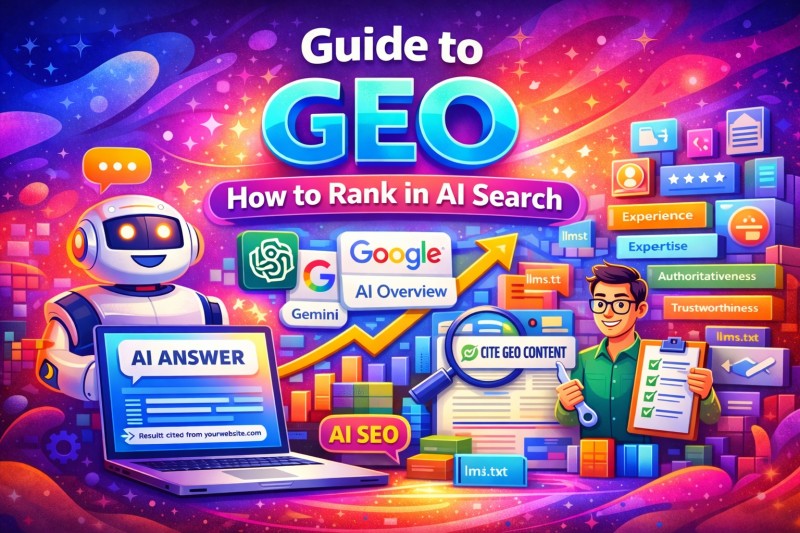
AI-powered search is changing the way people discover information online. Instead of scrolling through multiple websites, users now get direct answers from tools like ChatGPT, Google AI Overview, Gemini, and other AI assistants.
Search something on Google today, and you’ll often see an AI-generated summary at the top. Ask a question in ChatGPT, and you’ll get a complete answer within seconds—often without needing to click on any website.
This shift means one thing:
Ranking on Google is no longer enough. You need to become the source AI trusts and cites.
This is where Generative Engine Optimization (GEO) comes in.
In this guide, you’ll learn what GEO is, how it differs from SEO, and how to optimize your content to rank in AI-powered search.
What is GEO (Generative Engine Optimization)?
GEO (Generative Engine Optimization) is the process of optimizing your content so that AI tools can understand, use, and cite it in their responses.
Unlike traditional search engines, AI tools don’t just list websites—they:
- Analyze content
- Extract key information
- Summarize answers
- Cite trusted sources
Popular AI-powered platforms include:
- ChatGPT
- Google AI Overview
- Google Gemini
- Microsoft Copilot
- Perplexity AI
Instead of focusing only on rankings, GEO focuses on becoming the answer itself.
Why GEO Matters in 2026 and Beyond
AI search is growing rapidly and is expected to reshape the digital landscape.
Here’s why GEO is critical:
- AI-generated answers reduce clicks on traditional search results
- Users prefer instant, summarized responses
- AI tools prioritize trustworthy and structured content
- Brands cited by AI gain higher authority and trust
Studies suggest that AI-driven search traffic is increasing at a rapid pace and may soon rival traditional organic traffic.
Even more importantly, users coming from AI tools tend to convert better because:
- They receive precise answers
- They trust the source
- They are further along in the decision-making process
GEO vs SEO: What’s the Difference?
While GEO and SEO share some similarities, their goals and execution differ.
| Aspect | SEO | GEO |
|---|---|---|
| Focus | Ranking in search engines | Being cited in AI answers |
| Content | Long-form, keyword-focused | Clear, structured, answer-based |
| Optimization | Keywords, backlinks | Context, clarity, accuracy |
| Goal | Get clicks | Become the answer |
| Metrics | Traffic, rankings | Mentions, citations |
SEO helps you rank. GEO helps you get referenced.
The most successful strategy today is combining both.
How AI Tools Choose Content to Cite
AI tools don’t randomly pick content. They prioritize:
- Clear and direct answers
- Structured formatting
- Verified and factual information
- Trusted sources with authority
- Content that is easy to summarize
If your content is vague, overly promotional, or poorly structured, it is less likely to be used by AI systems.
How to Optimize Your Content for GEO
Let’s break down the most important strategies to rank in AI search.
1. Provide Clear and Direct Answers
AI tools prefer content that answers a question immediately.
Bad example:
“We provide innovative solutions designed to enhance your business growth.”
Good example:
“We are a digital marketing agency in New york helping businesses improve SEO, run ads, and generate leads.”
Start with a direct answer, then expand with details.
2. Use Structured Formatting
AI tools scan content in chunks, not long paragraphs.
Use:
- Headings (H2, H3)
- Bullet points
- Numbered steps
- Tables
- FAQs
This makes it easier for AI to extract and organize your content.
3. Add Schema Markup
Schema helps AI understand your content better.
Important schema types:
- Article
- FAQ
- Organization
- Product/Service
- Reviews
Structured data increases your chances of being selected as a reliable source.
4. Use Facts, Data, and Citations
AI favors content that is:
- Verifiable
- Data-backed
- Specific
Include:
- Statistics
- Case studies
- Dates
- Real examples
Whenever possible, cite trusted sources.
5. Write in a Conversational Tone
AI tools are designed to mimic human conversation.
Instead of keyword stuffing:
- Use natural language
- Answer real questions
- Focus on clarity
Think:
“How would I explain this to a person?”
6. Focus on Long-Tail Queries
AI tools are heavily question-based.
Examples:
- “How to fix indexing issues?”
- “What is GEO in SEO?”
- “How does AI search work?”
Create content around real user queries.
7. Keep Content Updated
Fresh content signals reliability.
Update:
- Statistics
- Examples
- Processes
- Screenshots
Outdated content is less likely to be used by AI.
8. Strengthen EEAT (Trust Signals)
Google and AI systems rely heavily on EEAT:
- Experience
- Expertise
- Authoritativeness
- Trustworthiness
Improve EEAT by adding:
- Author bio
- Testimonials
- Case studies
- Certifications
- Contact details
9. Build Off-Site Authority
AI doesn’t just look at your website—it looks across the web.
Build presence on:
- Social media
- Business directories
- Google Business Profile
- News articles
- Guest blogs
Consistency in brand information builds trust.
10. Use llms.txt File
Just like robots.txt guides search engines, llms.txt helps AI tools.
It allows you to:
- Guide AI crawlers
- Highlight important pages
- Control how your content is used
This is becoming an important part of GEO strategy.
Key GEO Performance Metrics
Unlike SEO, GEO success is measured differently:
- AI Visibility → How often your brand appears in AI answers
- Mentions → Number of times AI references your brand
- Citations → Pages used as sources
Tracking these helps evaluate your AI search presence.
Common Mistakes to Avoid
Avoid these GEO mistakes:
- Writing vague or generic content
- Overusing keywords
- Ignoring structure
- Not adding schema markup
- Outdated or thin content
- No off-site presence
These reduce your chances of being cited by AI.
The Future of GEO
AI search is still evolving, but one thing is clear:
👉 The way people search is changing permanently.
Businesses that adapt early will gain a major advantage.
Instead of competing for clicks, you’ll compete to:
- Be trusted
- Be cited
- Be the answer
Final Thoughts
GEO is not replacing SEO—it’s expanding it.
To succeed in AI search:
- Create clear, helpful content
- Structure it properly
- Build trust and authority
- Stay consistent across platforms
The sooner you start optimizing for AI, the better positioned you’ll be in the future of search.
FAQs
1. What is GEO in SEO?
GEO (Generative Engine Optimization) is the process of optimizing content for AI-powered search tools so it can be used and cited in AI-generated answers.
2. How is GEO different from SEO?
SEO focuses on ranking in search engines, while GEO focuses on being included in AI-generated responses.
3. Why is GEO important?
GEO helps your brand appear in AI answers, increasing visibility, authority, and conversions.
4. How do AI tools select content?
They prioritize structured, clear, factual, and trustworthy content.
5. What is llms.txt?
It is a file that helps guide AI crawlers on how to access and interpret your website content.
6. Does GEO replace SEO?
No, GEO complements SEO. Both are important for full visibility.
7. How can I improve AI visibility?
Focus on structured content, schema markup, strong EEAT, and off-site authority.